
 Français
 Español
 Deutsch
 Nederlands

 CBD
 CBN
 HEADSHOP
 Adaptogenic mushrooms

CBD law in France in 2026: what a retailer can sell, product by product
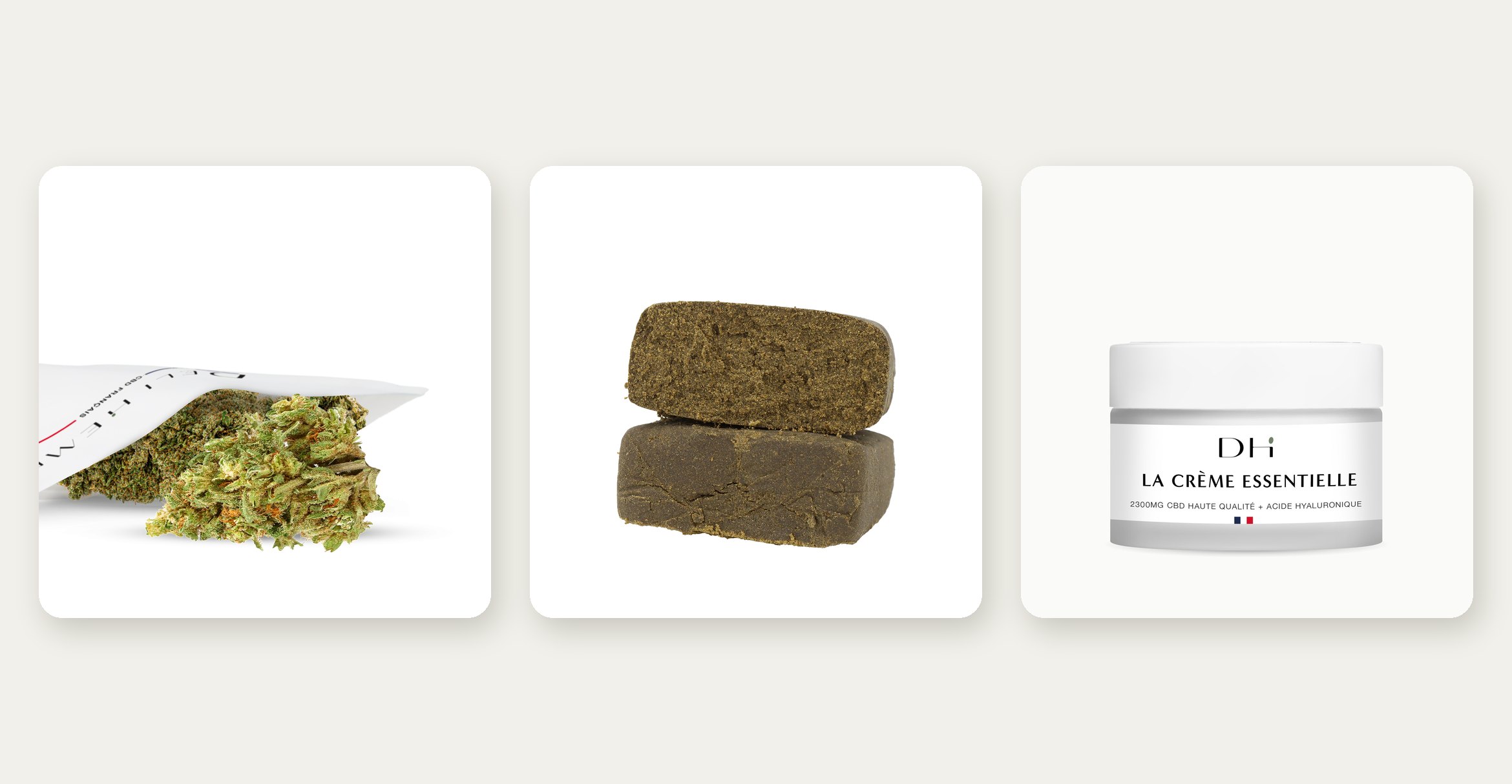
At the end of 2026, a shop in France can sell CBD flowers, resins, cosmetics and vape products, provided their delta-9-THC content does not exceed 0.3%. CBD food products, on the other hand, can no longer be sold: oils to be swallowed, gummies, capsules, drinks and infusions made from flowering tops were withdrawn from the market by the DGAL, France's food safety authority, on 15 May 2026.
This article describes French rules, as we apply them to the Deli Hemp catalogue. If you buy from a French wholesaler or follow Europe's largest CBD market, it tells you what is happening there. It does not describe the law in your own country: the status of hemp products varies across Europe, and in the UK the status of hemp flower remains contested, so check your local resale rules before ordering. Many online guides have not been updated since May 2026.
Which CBD products can be sold in France at the end of 2026?
What counts is how the product is meant to be used: the same oil is legal as a cosmetic and banned if it is sold to be swallowed.
| Product | Status at 22/10/2026 | Reference text | What the retailer checks |
|---|---|---|---|
| CBD hemp flowers | Permitted | Ministerial order of 30/12/2021; Conseil d'État ruling of 29/12/2022 | Batch analysis (THC ≤ 0.3%), variety listed in the EU catalogue |
| CBD resins, pollens and hash | Permitted | Same texts | Analysis matching the batch delivered, no added synthetic molecules |
| CBD oils for ingestion (sublingual, supplements) | Withdrawn since 15/05/2026 | Regulation (EU) 2015/2283, the Novel Food regulation | Stop selling them and take the stock off the shelf |
| Cosmetic oils and balms | Permitted | Regulation (EC) 1223/2009 | CPNP notification, responsible person in the EU, INCI list, no advice on oral use |
| Gummies, sweets, chocolate, drinks | Withdrawn since 15/05/2026 | Novel Food | Stop selling them |
| Hemp leaf infusions with no added extract | Tolerated under conditions (disputed point) | Traditional use of the leaves in water-based infusions | Leaves only, no flowering tops, THC ≤ 0.3% |
| Infusions of flowering tops or CBD-enriched infusions | Withdrawn | Novel Food, as read by the DGAL | Stop selling them |
| CBD e-liquids and vapes | Permitted | THC threshold of the 2021 order; French list of narcotics | No molecule classified as a narcotic (HHC and derivatives) |
| Hemp seeds, hemp seed oil | Permitted, including as food | Consumed before 1997 | No added CBD |
What does the 0.3% THC threshold mean in practice?
0.3% delta-9-THC means 3 milligrams of THC per gram of product. The French ministerial order of 30 December 2021 restricts the cultivation and commercial use of hemp to Cannabis sativa L. varieties listed in the catalogue whose THC content does not exceed that threshold.
The figure is assessed batch by batch: the same genetic can test at 0.12% one season and come close to the limit the next. In an inspection, only the analysis of the batch on your shelf counts.
In the shop, three habits are enough. File the analysis PDF for every batch. Check that the batch number on the certificate matches the one on the pouch. Reject any analysis that covers a different batch or is more than a year old. On our website, analyses are attached to the product pages that have one. For a reference without a PDF, ask your sales contact for it before ordering.
Why are CBD flowers legal in France when the 2021 order banned them?
Because the Conseil d'État, France's highest administrative court, struck down that ban on 29 December 2022. The 2021 order prohibited selling raw hemp flowers and leaves to consumers, even from authorised varieties. The judges found no evidence of a public health risk that would justify a general ban, and ruled it disproportionate.
In France, CBD is not classified as a narcotic, whereas THC is. The whole framework therefore rests on respecting the threshold and on traceability.
What happened to CBD food products on 15 May 2026?
The DGAL decided to apply the EU Novel Food regulation strictly. Since 2019, CBD extracts have been listed as "novel foods": without EU authorisation, they cannot go into a product meant to be eaten or drunk. The principle was loosely enforced for years. Since 15 May 2026, it has been enforced in France.
The decision covers sublingual oils sold as supplements, gummies, capsules, chocolate, drinks and infusions made from flowering tops. It does not cover products for smoking or vaping, cosmetics, seeds or hemp seed oil. Hemp leaves meant for a water-based infusion, with no added extract, remain defensible. The French trade body Union des professionnels du CBD disputes a reading it considers too restrictive, and industry organisations referred the matter to the Conseil d'État in June 2026. No ruling had been handed down when this page was last updated.
A common trap: an oil labelled "cosmetic" but presented in the shop with the advice "three drops under the tongue" will be treated as a food. The seller is answerable for what they say, not only for what is printed on the label.
Many French shops replaced oils for ingestion with skincare products and balms. Our range of CBD cosmetics for retailers falls under the cosmetics regulation, which the DGAL decision does not affect.
Where does EU authorisation of CBD as a food stand?
It does not exist yet. In February 2026, the expert panel of EFSA, the European Food Safety Authority, set a provisional safe intake of about 2 mg of CBD per day for a 70 kg adult, for CBD of at least 98% purity. In September 2026, EFSA issued its first favourable opinion on one specific synthetic CBD intended for food supplements, at 2 mg per day for adults aged 25 and over.
An EFSA opinion is not an authorisation. The European Commission still has to add the product to the Union list, and the authorisation would apply only to that product and that applicant. To put the gap with the market in perspective: a single drop of 10% oil already contains about 5 mg of CBD, more than twice the intake EFSA retained.
Will CBD flowers be taxed like tobacco in France?
That was the plan in Article 23 of the 2026 finance bill (the PLF, France's annual budget bill): create a category of "raw products for smoking that contain no tobacco", apply a tobacco-style excise duty to it and restrict its sale to licensed tobacconists. During the debates, the Senate voted to exclude CBD products from this duty, and the industry campaigned hard against the text.
In practice, we collect no excise duty on our flowers and resins, and specialist shops in France continue to sell them. Before you change your prices or sales channel on the strength of a press article, check the text actually in force on Légifrance, the official French legal database. That text is what counts, and we will update this page whenever it changes.
How should a French shop prepare for an inspection?
An inspection, whether by the DGCCRF (France's consumer protection and fraud authority), the DGAL, customs or the police, focuses mainly on traceability and on how products are presented. Have the following ready:
- a binder or shared folder with the analysis for every batch on the shelf
- supplier invoices showing the references and, where possible, the batch numbers
- labels with no health claims and with a "do not ingest" notice on flowers and resins
- no CBD food products left on the shelf or in the stockroom
- for cosmetics, the name of the responsible person and the CPNP notification (the EU cosmetics notification portal), which your supplier should be able to provide
For any question about the documents for a reference in our catalogue, our team in Nanterre, near Paris, can be reached on +33 1 76 21 79 22 or through the contact page.
Frequently asked questions
Is CBD legal in France in 2026?
Yes, under conditions. CBD flowers, resins, cosmetics and vape products can be sold if their delta-9-THC content does not exceed 0.3% and they come from authorised varieties. CBD food products (oils to swallow, gummies, drinks) have been withdrawn from the French market since 15 May 2026.
Can CBD oil still be sold in French shops?
Only as a cosmetic that complies with Regulation (EC) 1223/2009: CPNP notification, a responsible person in the EU, an INCI list. An oil presented for swallowing, or sold with advice to use it under the tongue, falls under the Novel Food rules and can no longer be sold in France.
Are hemp infusions banned in France?
Infusions of flowering tops, or infusions enriched with CBD, have been withdrawn since 15 May 2026. Infusions made only of hemp leaves, with no added extract and under 0.3% THC, remain defensible, but the point is disputed by the industry and may change. Check the exact composition of each reference.
What THC level is allowed in a CBD flower in France?
A maximum of 0.3% delta-9-THC, or 3 mg per gram. The threshold applies to the batch sold: keep the lab analysis for every batch, with a number that matches the one on the pouch. An analysis of the variety in general, or of another batch, is not enough in an inspection.
Sources
- Order of 30 December 2021 applying Article R. 5132-86 of the French Public Health Code, Légifrance (in French)
- Conseil d'État ruling of 29 December 2022 (in French)
- European Commission: Novel Food
- Regulation (EC) No 1223/2009 on cosmetic products
- Sud Radio: CBD food products banned from 15 May (in French)
- Vidal: CBD food supplements not authorised in the European Union (in French)
This article sets out French regulations as at the date shown and does not constitute legal advice.


